Monday, September 7, 2015

books in august

Bridget Jones's Diary, by Helen Fielding

This was the ultimate summer read.  Not only was it so lighthearted and funny and honest that I wanted to immediate write a book just like this one, it was the perfect way to pass the time while my family and I were on vacation in Annapolis.  Pure, sugary entertainment.  The movie was a good adaptation (I'd seen it before I read the book), and the casting was spot on.  I love that Mark Darcy is based on Colin Firth's portrayal of Mr Darcy in the P&P miniseries, and the movie has Colin Firth in that role.  It's all too perfect.  A little more sentimental than the book, but still so perfect.

Helen Fielding's writing style here is so approachable and funny.  I wish I would have thought of it first - segmented journal entries, beginning with an update on calories, cigarettes smoked, weight, and whatever else Bridget's keeping track of that week.  I should have written this book.  

Perelandra, by CS Lewis

Such a different book from the other one I read this month.  I struggled with Lewis's first book in his Space Trilogy (Out of the Silent Planet, which I wrote about two years ago - oy), and this one started little better.  His imagination creates literal worlds, and it takes half of a book to give the reader that setting.  The plot doesn't take off till you get a feel for your surroundings.  Is this to the detriment of the story itself?  Probably not.  We're just not used to having to stick with something that reads a little more... classically.  I've got to exercise that muscle a bit more.  By reading something tedious.

Halfway through, though, this book is anything but tedious.  All I'm going to say is the scene with the frogs.  True horror.  The Un-Man, as Ransom names the villain of this adventure, is truly horrifying.  He's reminiscent of Dracula to me... and I cannot really explain why.  I just know I felt the same terror and dread reading about his mutilation of this beautiful world of Lewis's imagination as I did about the vampire's activity.  Sheer evil.

No matter what Lewis writes, he rewards you for walking through his world, no matter how long the journey may have taken.  Please take this journey.  You won't be sorry.

books in july

The Pilgrim's Regress, by CS Lewis

I enjoyed this.  It's difficult for me to not enjoy something by my friend Jack.  However.  I felt like this was something I'd have written in a literary analysis course... obviously not to the same effect as his, but it was very much a response to a prompt, in my opinion.  The way he used names of literary/psychological/cultural movements was even more overt than Paul Bunyan's original Pilgrim story.  I realize this was one of his earlier works, post-conversion, and that it detailed (in allegorical form) that very conversion, but it certainly does not do justice to the imagination and brilliance we see in his other works.

Go Set a Watchman, by Harper Lee

A much-anticipated sequel to what is perhaps the great American novel did not live up to its hype.  My opinion.  While it was fun feeling like I was reading something out of a time capsule (Lee wrote this before To Kill a Mockingbird), the plot was undeveloped, and the characters were not likable.  The highlights were the flashbacks to Scout's childhood, naturally - that was the character we fell in love with in the first place.  I didn't like grown-up Scout.  When you read about a book about a precocious young girl, don't you automatically assume she would grow up to be just like you?  I know I do.  And did.  But Jean Louise is nothing like me.  And that made me dislike her.  Ha. 

Perhaps the biggest hit to my soul was the tainting of Atticus's character.  How dare she.  The greatest father in all of literature... is not.  It's a sad story.  It's a messy reality.  And what about Jem?  He's simply been dead, without much ado or explanation.  Eh.  Not what I wanted.  I feel a bit disillusioned with Atticus, and with Scout, strangely.  An interesting read, but certainly not on par with her first published novel.  Read that one again. 

books in june

The Shack, by Wm. P. Young

Oh, The Shack.  Although I was rereading it to discuss with a friend, I realized about halfway through that I had never finished it when it was assigned for my Triune God class at college.  Sorry, Dr Hirt!  But I aced the term paper, so....

The story was better than I remember it being, to be honest.  I empathize with Mack (the main character) more now that I have a daughter.  That section was truly heartbreaking, and caused me to ask some of those same questions he struggles through (e.g.: "Is God a good father?").  But the writing is still awful, the dialogue trite, and the characterization of God not necessarily accurate or helpful.  It's interesting, in its way, but ultimately, just not great.  Young brings up a great topic for discussion - the nature of the Triune God - but as far as the portrayal of God Himself, it often falls into the two main heresies surrounding that doctrine: either the Persons of the Godhead are too one (to the point of being indistinct), or too three (to the point of being too distinct and separate).  God is three in one.  The more we try to put this mystery into words, the more we try to rationalize, the farther I think we get from the truth.  Truly.

I also think, unintentional though it may be, the author falls into other heretical ideas.  It's probably for the sake of story, plot development, characterization, etc, but the fact remains that God the Father was not on the cross; there is a hierarchy within the Godhead; and the Bible is the reliable and necessary source of truth.  I don't appreciate the treatment of church and/or religion as a manmade god, either.  The church is the body and the bride of Christ.  All who claim Christ are not all His, obviously, and the church is full of fallen human beings who misrepresent Him all the time.  But we are called to structure and order and relationship with one another as well as on an individual basis with God.  

Are these points nitpicky?  Is it really just semantics?  As a work of fiction, can we gloss over these seemingly little details?  I suggest (firmly) no.  While I appreciate the portrayal of God in the way He will reach down into our lives, radically change our hearts, and demonstrate His nearness, I think it's closer to the heart of God to believe truth about who He is above a heartwarming and imaginative, but ultimately dishonest, dream sequence.  


This was such a timely read.  Written by Lewis in the format of letters to a fictional friend "Malcolm", this book answers many of the questions raised by Wm. P. Young in The Shack.  Jack's main discussion point is the way we relate to God, and how God relates to us.  Hence the "Chiefly on Prayer" subtitle.  In some ways, he supports the conclusions of The Shack: "We must lay before Him what is in us; not what ought to be in us."  God not only invites, but requires us to be honest with Him - in our moments of joy and especially in our times of despair.  He emphasizes the importance of communing with other believers through worship services, daily life, and the Lord's Supper; church is the way God relates to His people.  

The biggest, most important quote of the book in my eyes is, "Every idea of Him we form, He must in mercy shatter."  We as believers need to daily surrender our idea of who God is unto Him to be destroyed and built up in truth.  What a risky business is this faith!  

Friday, June 5, 2015

books in may

My Names Is Asher Lev, by Chaim Potok

I loved this.  Although it took me a bit to really get into the story and its characters, it had the same feel to me as A Tree Grows in Brooklyn.  The coming-of-age.  The setting, to some degree.  But since I have such a love for Judaism and the Jewish culture (especially in America), and as one who believes in Jesus as Messiah, Asher's story resonated with me on a deeper level.  The fact that his Crucifixion was far more offensive to his family and community than his nude paintings gives great insight into their morality.  It's sad.  And beautiful.  For a thinker, I highly recommend this book.

A Room with a View, by E.M. Forster

Yawn.  I'm so sorry - I wanted to enjoy this book.  I wanted it to be dripping with wit and sarcasm and a more scathing insight into the upper class of England during that time.  I wanted The Importance of Being Earnest.  Alas, what I was given was a bland narrative with sometime engaging and intriguing and real characters, and hints of wittiness.  I didn't finish this one, but knew what was coming.  I suppose the end justifies the boringness of the earlier chapters, but I don't care about Lucy and George in the slightest.

What Does the Bible Really Teach About Homosexuality?, by Kevin DeYoung

Such an informative read.  DeYoung really nails the reader with his knowledge and expansive research.  Do not read if you are looking for something other than simply what the title states -- what the Bible has to say on the topic.  There is less pastoral heart here (except in the later chapters); he rather focuses on the interpretation of controversial passages.  If you want to know biblically what to think about homosexuality, read this.  If you don't hold the Bible to be an authority, or know you will disagree with his conclusions anyway, I probably would not recommend it.  

Unbroken: A World War II Story of Survival, Resilience, and Redemption, by Laura Hillenbrand

Oh my goodness.  Kevin and I watched this movie the weekend before Memorial Day, and by the end of that following week, I had finished reading the book.  A few that I've talked to about it didn't care for the screen adaptation, but I think it was well done and actually spot on with casting and focus.  Obviously, it's long.  Both the movie and book dwell on Louie's horrific experiences and anguish, rather than on his ultimate redemption and the forgiveness he finds for himself and his captors in Christ.  The book delves far more into this.  Louie Zamperini was an incredible, seemingly indestructible man.  PLEASE READ THIS BOOK.  

An Outline History Of the Wesleyan Church, by Lee M. Haines

Maybe the most boring thing I've read since graduating college (when I was forced to read so many uninteresting books and articles for classes).  However, as my husband is now employed by a Wesleyan church, and I have no experience with the denomination myself, I thought it wise to get to know our new roots a bit more.  So, in that regard, I definitely feel I have a grasp on where the denomination came from, what Wesley himself actually believed and taught, and how the denomination morphed and grew and changed throughout its some odd 200 years of existence.  I just could've done without the record of presidents and leaders and Sunday School initiatives and periodicals.  

Monday, April 27, 2015

well this is embarrassing

It seems that the last time I posted about what I'm reading was... a week after Daphne was born.

So, a year and a half ago.

My bad.

Life is organized chaos lately, and no one better judge me for having little-to-no-time to read let alone WRITE about what I'm reading with a toddler always just around the corner getting into the dog food and one on deck about to make his appearance in ten weeks.  Seriously.

But since I value this, I'm going to continue my reading updates.  Starting with this year's.  So, here goes!


We listened to this on Audible while moving cross-country, and it was the perfect way to spend the time.  Cary Elwes (aka Westley) narrated, and other cast members contributed, so listening is the way to take this one in.  If you're a fan of The Princess Bride at all, you're missing out if you don't pick this up ASAP.  Fun anecdotes and tender moments shared by the cast and director reminded me just how special the film is, why it's such a success, and just how truly quotable and endearing it will always be to my family and me.  Love love love.

The Weight of Glory, by CS Lewis

And now for something completely different.... 
This collection of Lewis's essays and memorable lectures to various organizations, of which The Weight of Glory is most famous, is not exactly light reading.  He addresses important topics, though, that are as relevant now as they were then in the midst of the WWII and post-war England.  Jack once again succeeds to simultaneously crush with his brilliance (half of his arguments go about ten feet over my head?) and encourage with his still-grounded understanding of Christianity.  He's a genius, but he knows all knowledge is nothing if the hope of Christ is not communicated.  


I read this in a day.  What a thorough discussion of worship that is equally relevant to the layperson as the worship leader, in my opinion.  In it, a number of worship leaders and pastors communicate various aspects of worship in the church, but I was overwhelmingly encouraged that the majority of them made it a point to comment that while excellence is desirable, excellence in worship is not an end in itself.  It's all in vain if we miss the gospel and the God who requires our praise.  Yes.  This is what I want to see in our churches.  True gospel worship.  Read this book.


Can you tell I was on a worship kick for a bit there?  This one was good, but definitely for more of an average churchgoer.  And in that respect, it was spot on.  I liked the way Cosper walked through major events of the Bible and how each event corresponded with a new revelation of who God is and what worship should be.  A great biblical overview for students, in particular, I thought.  The rest of it was sort of blah to me, after having just read Doxology and Theology, which had a lot more weight and meat to its teaching.  Still would recommend.


Don't get me wrong... I love Bryson.  I've rents' house while Daph and I visited them for a week, just as a bit of light reading.  I've read at least five of his books, and they're all engaging and a fun read.  This one was no less.  But Neither Here nor There is also the first of his that I've read that's not about language, or Shakespeare, or something other than his own personal life.  As interesting as his meanderings through Europe are, it was sort of like turning on a travel show with a narrator whose voice you like who throws in a few cuss words and mildly naughty anecdotes to show he's authentic, and just having that on in the background while you do other stuff around the house.  That may be the best comparison I've ever come up with.  So I came away from this book feeling a bit meh toward it.  Not bad, but won't pick up again.


The idea of this book is far better than its actualization.  In a nutshell, Tom Standage walks the reader through history, detailing the development of six different beverages that at one stage or another influenced culture in an enduring way.  First, beer in ancient Mesopotamia.  Then, wine in Italy and Greece.  Spirits in America.  Coffee in the Middle East to Britain to America.  Tea in China, India, and Britain.  And finally, Coca-Cola in America and worldwide.  It could have been such a fascinating read, had Standage's writing style been more engaging than a (albeit thoroughly researched) senior thesis.  It ought to have been more lively, as a whole.  To his credit, things started picking up toward the middle, with the development of liquors and the importance of coffee in coffeehouses and the advancements that came about through the discussions that occurred over those beverages.  That is what I wanted in every chapter.  If you have any interest in world history, delicious beverages, and the social influences of pub- or coffeehouse-culture, you may want to pick this up.


Devotionals are not really my thing, but I picked this one up because Kevin left it on our counter, and I want to know more about the man who founded and inspired the denomination we're now a part of.  I was looking for a bit of an overview of John Wesley's life, and maybe a bit more about his personal beliefs of salvation and living in the power of Christ.  I found those things in this book, but Nick Harrison seems to have an earnest sort of infatuation with the man Wesley, and I just couldn't get past it.  I mean, I realize that the purpose of the devotional was to be encouraged by his life and challenged by his convictions, but he's still a man.  He had faults.  We can't put him on a pedestal like that, Nick Harrison.  For the next book I read on Wesley, I'd like to read about his struggles, about times he was humbled, times he stumbled and needed correction, and how he responded to that.  Do we have record of that?  That's what I want - stories of real human beings with active relationships with God that can be touch-and-go and shaky at times.  That's what's encouraging to me: when people choose God when the going gets rough and it hurts to be faithful, not these saints with no recorded flaws and perfect responses to every person with a question.  That's real life.  Give me a real person's story.  Please and thank you. 

Friday, November 29, 2013

happy birthday, dear jack


Happy 115th Birthday, dear Jack!
To celebrate, here are a few of my favorite quotes of his.
Read a book today.

Thursday, November 14, 2013

this is pathetic


It's been about three months since my last post.  It's not that I haven't been reading.  Because I have been.  Kinda.  I've been jumping from book to book for a while, and in doing so, haven't thought to write down any thoughts about these particular books.  But it's time for an update.  Please bear with me and my fragmented thoughts/sentences; I'm nearly in my right mind, and will use this occasion to pull the pregnancy card.

Since finishing the Shakespeare book by Bryson, I've sampled:
marriage books (The Sacred Romance, Real Marriage), 
novels/short stories (Ender's Game, The Jungle Books, The Scarlet Pimpernel, The Book Thief),
religious stuff (The Forgiveness Labyrinth, The Vine and the Trellis, The Mass)
other non-fiction (Made in America, The Professor and the Madman)

See?  I have been busy.  But not captured enough to finish one.  Obviously some of these I've read before.... Eh.  My eyes hurt.

Friday, August 2, 2013

Shakespeare: The World as Stage

Shakespeare: The World as Stage, by Bill Bryson

Such a satisfying read.  Finally.  Of course, considering the content, this one's pretty par for the course: it's hard to mess up Shakespeare for me.  (The only one who's ever done that is a certain undergrad professor of mine - who will remain unnamed, although that's probably an unnecessary courtesy.  She said once, literally, "Shakespeare was a pretty good writer for his time," as we read through his masterpiece Hamlet.)  This book is comparatively well-informed and -researched, with a substantial bibliography (many works of which I already own.  Yes!)

Shakespeare is a delightful, engaging, and succinct overview of the main points of one William Shakespeare's life.  Bryson discusses and probes various theories to the overwhelming silence of Shakespeare's life outside his plays and poetry, and gives the reader clear understanding of what we may believe to be true, without tremendous assumption (which, unfortunately, Shakespeare scholars and aficionados are wont to do.) 

In regards to his schooling, for instance, Bryson puts it this way:
Shakespeare's genius had to do not really with facts, but with ambition, intrigue, love, suffering -- things that aren't taught in school.  He had a kind of assimilative intelligence, which allowed him to pull together lots of disparate fragments of knowledge, but there is almost nothing that speaks of hard intellectual application in his plays -- unlike, say, those of Ben Jonson, where learning hangs like bunting on every word.  Nothing we find in Shakespeare betrays any acquaintance with Tacitus, Pliny, Suetonius, or others who influenced Johnson and were second nature to Francis Bacon.  That is a good thing -- a very good thing indeed -- for he would almost certainly have been less Shakespeare and more a showoff had he been better read.  As John Dryden put it in 1668: "Those who accuse him to have wanted learning, give him the greater commendation: he was naturally learn'd."
And so, we love him for his humanity.

Bryson also addresses the various theories as to who Shakespeare "really" was (e.g. Marlowe, Bacon, de Vere.)  He sheds light on the origins of these theories - briefly, thank God - and concludes thusly:
In short it is possible, with a kind of selective squinting, to endow the alternative claimants with the necessary time, talent, and motive for anonymity to write the plays of William Shakespeare.  But what no one has ever produced is the tiniest particle of evidence to suggest that they actually did so.  These people must have been incredibly gifted -- to create, in their spare time, the greatest literature ever produced in English, in a voice patently not their own, in a manner so cunning that they fooled virtually everyone during their own lifetimes and for four hundred years afterward.  The Earl of Oxford, better still, additionally anticipated his own death and left a stock of work sufficient to keep the supply of new plays flowing at the same rate until Shakespeare himself was ready to die a decade or so later.  Now that is genius!
Haha.  Oh, Bill Bryson.  Thank you for charming me once again.  

Tuesday, July 23, 2013

i'm stuck

Here I am on my day off.
I just finished twenty pages of one book,
and here I am watching The Breakfast Club.
I'm stuck.
I'm in the middle of these two books, and I'm bored out of my mind.
Yet - 
despite the fact that I have seven+ recently purchased books sitting on my shelf
taunting me - 
I cannot move past them just yet.  
So I read twenty pages at a time.
Inching along.
Prolonging my fictive misery.
Blech.  
What do I do?
Move on?
Power through?
Stop whining and do something active?
Please advise me.

Here are the two books I'm stuck in.

The Soloist, by Steve Lopez

It's the good and true story of a journalist who meets a Julliard-educated homeless man playing a violin with two strings.  
He befriends this man, writes an article, and begins a journey with him.  
Mental health, 
classical music, 
the state of the homeless in Los Angeles, 
and the unsteady friendship between two men make for an interesting read, right?  
Wrong.  
Sure, the content is fantastic, but Mr Lopez's writing style is... bland.
Knowing him to be a journalist, and this to be his own story, I was anticipating something more along the lines of a Tuesdays with Morrie a la Mitch Albom.
With Lopez, I'm hardly engaged.
There was a movie based on this book a few years back, starring Robert Downey Jr and Jamie Foxx.
Even when I saw it in theatres, the premise was so good, but the movie was slow.
Not as slow as this book.
Egghhhhh 170 pages left.
  

Death Comes to Pemberley, by P.D. James

It's a natural choice.  The sequel to Austen's classic Pride and Prejudice.  
I ought to love everything about it.
But I don't.
P.D. James may be a brilliant crime writer and important person in literature.
But, for all I know, this book doesn't work.
The vivid personalities Austen introduced to the world fall lifeless (no pun intended) under James's pen.
I may only be fifty pages in, so perhaps I've got to give her a break and a chance, but I don't want to.
Meh.  Another I want to finish, but I'm so bored!

Wednesday, June 12, 2013

The Devil Wears Prada

The Devil Wears Prada, by Lauren Weisberger

Such a fun, fluff summer read!  As I was already a fan of the movie, I was delighted to find that the book was not all that different.  

**************Some spoilers ahead detailing differences between book & movie - STOP now and read the book if you want to be surprised! **************

Though decently written with vivid descriptions, the language (lottttttsssssss of F-words) was a little disappointing.  

She doesn't ever sleep with Christian in Paris.  YAY for the morality of the character, but I do wish Weisberger had spent more time developing that little flirtatious relationship.  It was fun.  :)

The story is told from Andrea's point of view, which causes the reader to commiserate a bit more with her character.  Unlike in the movie, Anne Hathaway's portrayal of Andy makes you want to hate her just a bit when she becomes absorbed in Miranda Priestly's world.  The novel's Andy, because we the readers are privy to her thoughts, is much more likable.  

Her boyfriend, named Alex - not Nate - is a saint.  He teaches at an underprivileged urban school, typically goes above and beyond in the classroom and extracurricularly, and is something of a frustrating character for that very reason.  He's as much a workaholic as Andy is.  Perhaps that's due to her lifestyle, and the changes therefore in their relationship.  Hmm.  Regardless.  He's not brooding; he's not a chef; and he's more manly, I think, than Adrien Grenier's Nate.

Certain characters are combined in the movie.  Stanley Tucci's character Nigel plays a relatively insignificant role in the book - maybe five whole sentences in the entire 375 page novel - but combined with the characters James and Jeffy of the book, Nigel comes to life on screen.  

Miranda's British, and Emily's not.

Lily, Andy's best friend, is pretty trampy.  The story weaves her story into Andy's... mainly due to the drama Lily causes.  It's Lily's alcoholism that brings about the climax of the story.

The novel ends dramatically differently than the movie.  There is no mutual respect between Miranda and Andy.  They have a significant falling-out, actually.  But this falling-out causes Andrea to receive several consequential job offers.  

**************End of spoilers!**************

Easy-peasy summer reading.  So much fun.  If you liked the movie, you will LOVE the book.  And I guarantee that you will feel like you need Prada and Gucci products after this one.  I don't even know what such brands look like, except in my imagination... but I want them.

Tuesday, June 11, 2013

The Search for God and Guinness

The Search for God and Guinness, by Stephen Mansfield

Such a delightful and engaging read!  From the history of beer itself to the (rather in-depth) history of this particular brewery, Mansfield takes the reader through the social, religious and political journey of the Guinness family.  

I was surprised by the way the Guinness family almost single-handedly saved the city of Dublin during crisis.  The care, the flexibility, and the proactivity of these visionaries demonstrated that this company was grounded with an understanding of the grace of God, and the responsibility to affect change in their community and world.  Seriously.  This family was involved.

Sounds sappy from the way I describe it, and I'm sorry.  It's not.  It's informative.  It's inspiring.  It got a little boring for a significant portion of the mid-chapters.  But stick with it.  

If you're a fan of Guinness the stout, you oughta read this book.  
If you're a fan of history, or Ireland, you oughta read this book.  
If you like missionary stories, you oughta read this book. 
If you like well-written books with a journalistic feel, you oughta read this book.

Tuesday, June 4, 2013

recent additions

I have an addiction to buying books.
I just hafta.

My recent finds at a local thrift store:

The Chosen, by Chaim Potok (have already read)
Davita's Harp, Potok
The Book of Lights, Potok
The Five People You Meet in Heaven, Mitch Albom (have already read)
The Devil Wears Prada, Lauren Weisberger
The Search for God and Guinness, by Stephen Mansfield (currently reading)

Sunday, June 2, 2013

The Red Pony

The Red Pony, by John Steinbeck

I read this one this afternoon.  It was a glorious day: I was working on my tan, sitting on one of our new lawn chairs... glorious. 

While I don't consider myself a Steinbeck fan, I do appreciate his writing from time to time.  This most recent one reminded of me why I equally like and loathe him.  He certainly creates a scene, develops an interesting character, and causes you to care.  At the same time, however, I find that he revels in the despair of the time period.  I hate how he makes me like a character and then either kills them off or causes them to experience emotional or physical hardship.  Heartbreaking.  

Sigh.  I cannot deny, though, that I truly enjoyed The Red Pony.  I loved the relationship between Jody and Billy Buck.  Billy, the hired hand, had the most depth, I think, of the characters.  I also loved Grandfather and how he was unable to give up his thrilling adventure in the past.  Jody, the boy, essentially told the story; through that, I was given insight into his thoughts and emotional responses, but I cared more about the surrounding characters, to be honest.

Read it.  It'll take you maybe two hours. 

Saturday, June 1, 2013

Ella Enchanted

Ella Enchanted, by Gail Carson Levine

Ella Enchanted was one of my absolute favorite books growing up.  I love Ella's spunkiness, I love the creativity of the plot despite the Cinderella cliche, I love the first person narrative.  And, having not read it in perhaps over ten years, I was reminded how absurd and awful the film version actually is.  Why could they have not just stuck with the perfect story in front of them?  It's far more intriguing, compelling, and there is no room for horrifying musical numbers!  

Regardless, this was a wonderful kick start to my summer reading list!  Read it if you haven't yet, and if you have, read it again!  

Tuesday, May 28, 2013

The Other Tudors

The Other Tudors, by Philippa Jones

Little did I know that Henry VIII, one of my favorite characters in all of history, had multiple illegitimate children, let alone plenty of potential male heirs, had they been legitimate.  I suppose that reveals my naivete toward his lifestyle (and the lifestyle of many in his position in that day).  However, this book opened my eyes, to say the least.  Not in a sensational way; Jones merely presents her research, devoting each chapter to the individuals: mistress or bastard or both, as not every affair resulted in a child.  Though Jones' writing is not sensational, it is sentimental.  Take her conclusion for instance:
Henry VIII was a man who longed for love.  His tragedy was that he was looking for love that could never exist.  He had a vision of the perfect woman, an image of his mother, and no woman could measure up to this fantasy.  Apart from this was the obsessive need for a male heir.  These two, together with the power struggles going on amongst the noble families and foreign diplomats, distorted Henry's natural desire to love and, most of all, to be loved.  
Yuck, really?  Please!  Even I, a fan of Henry's, want to gag at this schmalz.  Beyond this, she seems to consider herself the authority on every matter.  Too many paragraphs begin, "Historian So-and-So states such-and-such a timeline, or what's-her-name was close to the king at this point, but that is incorrect...."  I didn't take a lot of time to peruse her endnotes, but not many of her assertions are backed up in order to truly disprove the actual historians' findings.

That all being said, I enjoyed this book immensely.  Henry is fascinating, sentimental lovesick sap or not, and so are his subsequent children, real or alleged.

Sunday, May 19, 2013

Out of the Silent Planet

Out of the Silent Planet, by CS Lewis

So maybe it's been seven months since my last book review... maybe I've been exhausted and watching too much Friends and sleeping and moving from house to house. 

Regardless.  This rather short novel took me a shameful amount of time to read.  My mind needed to be reoriented to read A) fiction, and B) sci-fi.  I really take for granted the fact that genres must be read differently, and I've been reading non-fiction like it's my job.  

Supposedly, this trilogy was born of a discussion between Jack and his friend Tolkien, lamenting the state of contemporary fiction.  Sigh, Jack.  Glad you're not around to see what they're putting out nowadays.

It's almost not necessary to comment on Jack's lush and imaginative descriptions.  I so appreciate the way he paints a scene into the reader's mind... even if the scene is so other.  I got lost in Malacandra.  

I'll be honest, this book started strong for me, got sleepy in the middle parts, and then it was all made worth it with the conversation/interrogation between Oyarsa and Ransom at the end.  Read it.  You'll see.

Thursday, January 10, 2013

recently added


Yes, yes I know.
I'm hopeless.

But I found these in a thrift store.
For less than a dollar.
So.
I had to.

Robinson Crusoe & Shakespeare & the Art of Verbal Seduction.
AKA classics.

Sunday, January 6, 2013

and it begins...

Merry Christmas to me!

The top five books, 
I found at the Habitat for Humanity ReStore
for fifty cents each. 

A collection of Ray Bradbury short stories.
Ella Enchanted; a favorite of mine growing up.
The Pursuit of Holiness; I lent mine to a friend, who never returned it.
The Mayor of Casterbridge; because I love Thomas Hardy.
The Silmarillion; because I need it.

The set of The Lord of the Rings + The Hobbit
were a Christmas present from Austin.

What a great start to the year.  :)

Saturday, November 17, 2012

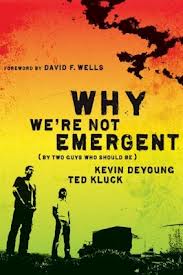
Why We're Not Emergent

Why We're Not Emergent (By Two Guys Who Should Be), by Kevin DeYoung and Ted Kluck

This is one I've been working on for... a while.  The 'emergent movement' is a relevant and important issue conversation that all serious Christians ought to engage.  As I think about the manner Kevin and I can portray our faith to the largely unreached Idaho Springs community, I want to guard against sacrificing foundational things for the sake of relevance... as the use of Scripture and the understanding of God and His Church are being redefined in the emergent movement. 
From the intro: 
One of its critics has described the emerging church as a protest movement - a a protest against traditional evangelicalism, a protest against modernism, and a protest against seeker-sensitive megachurches.  Others, sympathetic to the movement have used the acronym EPIC: experiential, participatory, image driven, and connected.
The reason we (more "mainstream") evangelical Christians must take this movement seriously is that it is gaining followers with an attractive message.  Doesn't sound too horrible, right?  But at what cost:
-demoting to mere story the Holy Word of God, 
-reducing the Almighty to a weak (albeit all-loving) power with no semblance of majesty, holiness, or justice, or 
-redefining Church to mean an all-inclusive community of fellow journeyers with little direction beyond "live as Jesus lived"?  
One of the authors described the 'theology' thus: It reaffirms my place in the center of my own universe.  It's about me and my journey.  Is this true Gospel?  Or is it a dangerous sort of placebo for people who have been burned by traditional church, or seekers who can't tell the difference?  Ours is a religion that cannot be compromising to this self-serving, trendy culture.

The dangers of compromising Scripture:
We can wax eloquent about the beauty of the story and how the Scriptures read us, but unless people are convinced that the Bible is authoritative, true, inspired, and the very words of God, over time they will read it less frequently, know it less fully, and trust it less surely. 
The dangers of compromising who God is:
Where sin is the main problem we need a crucified Substitute.  Where pain and brokenness are the main problems, we need to learn to love ourselves.  God is no longer a holy God angry with sin, who, in His great mercy, sent His Son to die on our behalf so that divine justice might be satisfied.  God becomes a vulnerable lover who opens Himself up to hurt and rejection in order to be with us because we are worth dying for. 
I have no doubt that this message will find a receptive audience, but it is not the message the apostles proclaimed and for which they died.  Christians don't get killed for telling people that God believes in them and suffers like them and can heal their brokenness.  They get killed for calling sinners to repentance and proclaiming faith in the crucified Son of God as the only means by which we who were enemies might be reconciled to God (Rom. 5:10). 
The dangers of compromising church - who's in, and its structure:
There is a log of ambiguity, like "take part in spiritual activities" and "identify with the life of Jesus."  Then the thought came to me, If you stopped a random handful of Americans on the street, they would all aspire to identifying with the life of Jesus in much the same way they would hope to identify with the life of Martin Luther King or Muhammad Ali.  The tough part is that "taking part in spiritual activities" won't help a person in the afterlife, regardless of whether or not McLaren is ready to dialogue on that topic.  
...Many in the emerging church lament the central place preaching has received in Protestant worship services.  Pagitt, for example, decries how preaching has becoming "speaching."...The problem, according to emergent leaders, isn't with the people or the preachers, but with the method of one-way communication where one clear message is spoken to passive listeners.  ...Much of the emergent disdain for preaching is really an uneasiness about authority and control.  Discussion, yes.  Dialogue, yes.  Group discernment, yes.  Heralding?  Proclamation?  Not on this side of modernism.
In the final chapter, the authors urge us to consider the examples of the seven churches in the book of Revelation.  There is a message of warning for us, in the camp of the traditional and orthodox church,
The light at Ephesus had grown dim.  They had good deeds, but not in love for one another.  They defended the light, but they were not shining it into the dark places of the world.  ...It is sad but true.  Theologically astute churches and theologically minded pastors sometimes die of dead orthodoxy.  Some grow sterile and cold, petrified as the frozen chosen, not compromising with the world, but not engaging it either.  We may think right, live right, and do right, but if we do it off in a corner, shining our lights at one another to probe our brother's sins instead of pointing our lights out into the world, we will, as a church, grow dim, and eventually our light will be extinguished.  
and for them, the all-inclusive and organic emergent church,
Ephesus was under-engaged with the culture; Pergamum over-identified with the culture.  The Christians in Pergamum bore witness to Jesus, but they had compromised in what it meant to follow Him.  Undiscerning tolerance was Pergamum's crippling defect.  Their indifference to religious and moral deviancy was not a sign of their great relevance to the culture, or their great broadmindedness, or a great testimony to their ability to focus on God's love; it was a blight on their otherwise passionate, faithful witness.
To conclude:
Emergent Christians, to use the language of Revelation, have many good deeds.  They want to be relevant.  They want to reach out.  They want to be authentic.  They want to include the marginalized.  They want to make kingdom disciples.  They want community and life transformation.  Jesus likes all this about them.  But He would, I believe, also have some things against them, some critiques to speak through other brothers and sisters.  Criticisms that shouldn't be sidestepped because their movement is only a "conversation," or because they only speak for themselves, or because they admit, "We don't have it all figured out."  Emergent Christians need to catch Jesus' broader vision for the church - His vision for a church that is intolerant of error, maintains moral boundaries, promotes doctrinal integrity, stands strong in times of trial, remains vibrant in times of prosperity, believes in certain judgment and certain reward, even as it engages the culture, reaches out, loves, and serves.  We need a church that reflects the Master's vision - one that is deeply theological, deeply ethical, deeply compassionate, and deeply doxological. 
This seems to me a message we all need to "catch".  

Thursday, November 8, 2012

something droll

Considering I've had such a lack of motivation to read (and, therefore, to write)... 
...here's something droll I found online.  
But in reality, I would love for someone to give out these awards.  To me.
Which one(s) would you want to win?