Showing posts with label love. Show all posts

Thursday, November 14, 2013

this is pathetic


It's been about three months since my last post.  It's not that I haven't been reading.  Because I have been.  Kinda.  I've been jumping from book to book for a while, and in doing so, haven't thought to write down any thoughts about these particular books.  But it's time for an update.  Please bear with me and my fragmented thoughts/sentences; I'm nearly in my right mind, and will use this occasion to pull the pregnancy card.

Since finishing the Shakespeare book by Bryson, I've sampled:
marriage books (The Sacred Romance, Real Marriage), 
novels/short stories (Ender's Game, The Jungle Books, The Scarlet Pimpernel, The Book Thief),
religious stuff (The Forgiveness Labyrinth, The Vine and the Trellis, The Mass)
other non-fiction (Made in America, The Professor and the Madman)

See?  I have been busy.  But not captured enough to finish one.  Obviously some of these I've read before.... Eh.  My eyes hurt.

Wednesday, June 12, 2013

The Devil Wears Prada

The Devil Wears Prada, by Lauren Weisberger

Such a fun, fluff summer read!  As I was already a fan of the movie, I was delighted to find that the book was not all that different.  

**************Some spoilers ahead detailing differences between book & movie - STOP now and read the book if you want to be surprised! **************

Though decently written with vivid descriptions, the language (lottttttsssssss of F-words) was a little disappointing.  

She doesn't ever sleep with Christian in Paris.  YAY for the morality of the character, but I do wish Weisberger had spent more time developing that little flirtatious relationship.  It was fun.  :)

The story is told from Andrea's point of view, which causes the reader to commiserate a bit more with her character.  Unlike in the movie, Anne Hathaway's portrayal of Andy makes you want to hate her just a bit when she becomes absorbed in Miranda Priestly's world.  The novel's Andy, because we the readers are privy to her thoughts, is much more likable.  

Her boyfriend, named Alex - not Nate - is a saint.  He teaches at an underprivileged urban school, typically goes above and beyond in the classroom and extracurricularly, and is something of a frustrating character for that very reason.  He's as much a workaholic as Andy is.  Perhaps that's due to her lifestyle, and the changes therefore in their relationship.  Hmm.  Regardless.  He's not brooding; he's not a chef; and he's more manly, I think, than Adrien Grenier's Nate.

Certain characters are combined in the movie.  Stanley Tucci's character Nigel plays a relatively insignificant role in the book - maybe five whole sentences in the entire 375 page novel - but combined with the characters James and Jeffy of the book, Nigel comes to life on screen.  

Miranda's British, and Emily's not.

Lily, Andy's best friend, is pretty trampy.  The story weaves her story into Andy's... mainly due to the drama Lily causes.  It's Lily's alcoholism that brings about the climax of the story.

The novel ends dramatically differently than the movie.  There is no mutual respect between Miranda and Andy.  They have a significant falling-out, actually.  But this falling-out causes Andrea to receive several consequential job offers.  

**************End of spoilers!**************

Easy-peasy summer reading.  So much fun.  If you liked the movie, you will LOVE the book.  And I guarantee that you will feel like you need Prada and Gucci products after this one.  I don't even know what such brands look like, except in my imagination... but I want them.

Saturday, June 1, 2013

Ella Enchanted

Ella Enchanted, by Gail Carson Levine

Ella Enchanted was one of my absolute favorite books growing up.  I love Ella's spunkiness, I love the creativity of the plot despite the Cinderella cliche, I love the first person narrative.  And, having not read it in perhaps over ten years, I was reminded how absurd and awful the film version actually is.  Why could they have not just stuck with the perfect story in front of them?  It's far more intriguing, compelling, and there is no room for horrifying musical numbers!  

Regardless, this was a wonderful kick start to my summer reading list!  Read it if you haven't yet, and if you have, read it again!  

Tuesday, May 28, 2013

The Other Tudors

The Other Tudors, by Philippa Jones

Little did I know that Henry VIII, one of my favorite characters in all of history, had multiple illegitimate children, let alone plenty of potential male heirs, had they been legitimate.  I suppose that reveals my naivete toward his lifestyle (and the lifestyle of many in his position in that day).  However, this book opened my eyes, to say the least.  Not in a sensational way; Jones merely presents her research, devoting each chapter to the individuals: mistress or bastard or both, as not every affair resulted in a child.  Though Jones' writing is not sensational, it is sentimental.  Take her conclusion for instance:
Henry VIII was a man who longed for love.  His tragedy was that he was looking for love that could never exist.  He had a vision of the perfect woman, an image of his mother, and no woman could measure up to this fantasy.  Apart from this was the obsessive need for a male heir.  These two, together with the power struggles going on amongst the noble families and foreign diplomats, distorted Henry's natural desire to love and, most of all, to be loved.  
Yuck, really?  Please!  Even I, a fan of Henry's, want to gag at this schmalz.  Beyond this, she seems to consider herself the authority on every matter.  Too many paragraphs begin, "Historian So-and-So states such-and-such a timeline, or what's-her-name was close to the king at this point, but that is incorrect...."  I didn't take a lot of time to peruse her endnotes, but not many of her assertions are backed up in order to truly disprove the actual historians' findings.

That all being said, I enjoyed this book immensely.  Henry is fascinating, sentimental lovesick sap or not, and so are his subsequent children, real or alleged.

Thursday, January 10, 2013

recently added


Yes, yes I know.
I'm hopeless.

But I found these in a thrift store.
For less than a dollar.
So.
I had to.

Robinson Crusoe & Shakespeare & the Art of Verbal Seduction.
AKA classics.

Saturday, November 17, 2012

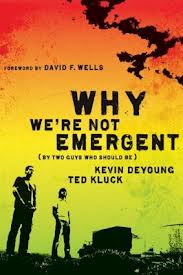
Why We're Not Emergent

Why We're Not Emergent (By Two Guys Who Should Be), by Kevin DeYoung and Ted Kluck

This is one I've been working on for... a while.  The 'emergent movement' is a relevant and important issue conversation that all serious Christians ought to engage.  As I think about the manner Kevin and I can portray our faith to the largely unreached Idaho Springs community, I want to guard against sacrificing foundational things for the sake of relevance... as the use of Scripture and the understanding of God and His Church are being redefined in the emergent movement. 
From the intro: 
One of its critics has described the emerging church as a protest movement - a a protest against traditional evangelicalism, a protest against modernism, and a protest against seeker-sensitive megachurches.  Others, sympathetic to the movement have used the acronym EPIC: experiential, participatory, image driven, and connected.
The reason we (more "mainstream") evangelical Christians must take this movement seriously is that it is gaining followers with an attractive message.  Doesn't sound too horrible, right?  But at what cost:
-demoting to mere story the Holy Word of God, 
-reducing the Almighty to a weak (albeit all-loving) power with no semblance of majesty, holiness, or justice, or 
-redefining Church to mean an all-inclusive community of fellow journeyers with little direction beyond "live as Jesus lived"?  
One of the authors described the 'theology' thus: It reaffirms my place in the center of my own universe.  It's about me and my journey.  Is this true Gospel?  Or is it a dangerous sort of placebo for people who have been burned by traditional church, or seekers who can't tell the difference?  Ours is a religion that cannot be compromising to this self-serving, trendy culture.

The dangers of compromising Scripture:
We can wax eloquent about the beauty of the story and how the Scriptures read us, but unless people are convinced that the Bible is authoritative, true, inspired, and the very words of God, over time they will read it less frequently, know it less fully, and trust it less surely. 
The dangers of compromising who God is:
Where sin is the main problem we need a crucified Substitute.  Where pain and brokenness are the main problems, we need to learn to love ourselves.  God is no longer a holy God angry with sin, who, in His great mercy, sent His Son to die on our behalf so that divine justice might be satisfied.  God becomes a vulnerable lover who opens Himself up to hurt and rejection in order to be with us because we are worth dying for. 
I have no doubt that this message will find a receptive audience, but it is not the message the apostles proclaimed and for which they died.  Christians don't get killed for telling people that God believes in them and suffers like them and can heal their brokenness.  They get killed for calling sinners to repentance and proclaiming faith in the crucified Son of God as the only means by which we who were enemies might be reconciled to God (Rom. 5:10). 
The dangers of compromising church - who's in, and its structure:
There is a log of ambiguity, like "take part in spiritual activities" and "identify with the life of Jesus."  Then the thought came to me, If you stopped a random handful of Americans on the street, they would all aspire to identifying with the life of Jesus in much the same way they would hope to identify with the life of Martin Luther King or Muhammad Ali.  The tough part is that "taking part in spiritual activities" won't help a person in the afterlife, regardless of whether or not McLaren is ready to dialogue on that topic.  
...Many in the emerging church lament the central place preaching has received in Protestant worship services.  Pagitt, for example, decries how preaching has becoming "speaching."...The problem, according to emergent leaders, isn't with the people or the preachers, but with the method of one-way communication where one clear message is spoken to passive listeners.  ...Much of the emergent disdain for preaching is really an uneasiness about authority and control.  Discussion, yes.  Dialogue, yes.  Group discernment, yes.  Heralding?  Proclamation?  Not on this side of modernism.
In the final chapter, the authors urge us to consider the examples of the seven churches in the book of Revelation.  There is a message of warning for us, in the camp of the traditional and orthodox church,
The light at Ephesus had grown dim.  They had good deeds, but not in love for one another.  They defended the light, but they were not shining it into the dark places of the world.  ...It is sad but true.  Theologically astute churches and theologically minded pastors sometimes die of dead orthodoxy.  Some grow sterile and cold, petrified as the frozen chosen, not compromising with the world, but not engaging it either.  We may think right, live right, and do right, but if we do it off in a corner, shining our lights at one another to probe our brother's sins instead of pointing our lights out into the world, we will, as a church, grow dim, and eventually our light will be extinguished.  
and for them, the all-inclusive and organic emergent church,
Ephesus was under-engaged with the culture; Pergamum over-identified with the culture.  The Christians in Pergamum bore witness to Jesus, but they had compromised in what it meant to follow Him.  Undiscerning tolerance was Pergamum's crippling defect.  Their indifference to religious and moral deviancy was not a sign of their great relevance to the culture, or their great broadmindedness, or a great testimony to their ability to focus on God's love; it was a blight on their otherwise passionate, faithful witness.
To conclude:
Emergent Christians, to use the language of Revelation, have many good deeds.  They want to be relevant.  They want to reach out.  They want to be authentic.  They want to include the marginalized.  They want to make kingdom disciples.  They want community and life transformation.  Jesus likes all this about them.  But He would, I believe, also have some things against them, some critiques to speak through other brothers and sisters.  Criticisms that shouldn't be sidestepped because their movement is only a "conversation," or because they only speak for themselves, or because they admit, "We don't have it all figured out."  Emergent Christians need to catch Jesus' broader vision for the church - His vision for a church that is intolerant of error, maintains moral boundaries, promotes doctrinal integrity, stands strong in times of trial, remains vibrant in times of prosperity, believes in certain judgment and certain reward, even as it engages the culture, reaches out, loves, and serves.  We need a church that reflects the Master's vision - one that is deeply theological, deeply ethical, deeply compassionate, and deeply doxological. 
This seems to me a message we all need to "catch".  

Monday, October 1, 2012

Jane Eyre

Jane Eyre, by Charlotte Brontë

Ah.  Good fictional literature.  It's been a while.  What is there to say but that Jane Eyre lives up to its status as a staple in the Western canon.  Having read it nearly ten years ago, there was not much I remembered about the heroine, nor Ms. Brontë's lush descriptions.  I had forgotten so much, it may as well have been my first time.  Ah.  

Reading her story, I am so proud of Jane.  And why shouldn't I be?  Faced with tremendous temptation, she replies
I care for myself.  The more solitary, the more friendless, the more unsustained I am, the more I will keep the law given by God; sanctioned by man. I will hold to the principles received by me when I was sane, and not mad--as I am now. Laws and principles are not for the times when there is no temptation: they are for such moments as this, when body and soul rise in mutiny against their rigour; stringent are they; inviolate they shall be. If at my individual convenience I might break them, what would be their worth? They have a worth--so I have always believed; and if I cannot believe it now, it is because I am insane--quite insane: with my veins running fire, and my heart is beating faster than I can count its throbs. Preconceived opinions, foregone determinations, are all I have at this hour to stand by: there I plant my foot.
Good grief, Jane!  Way to make all the rest of us women feel horrible about decisions we've made against the law of God and man... And yet by your example, you remind us that we, too, can choose to plant our feet, and that a choice for good will not be in vain.

This book explores, at length, gender relations, social class, grace and law, atonement, real romance, integrity, and education.  All things that I love.

It's almost a cliché to recommend this book.  But seriously, if you haven't yet read it, you cannot claim to love literature.  This is no exaggeration.

I hear the movie version with Mia Wasikowska and Michael Fassbender is a rather faithful portrayal.  Cannot wait to see it!

Monday, September 24, 2012

recent purchases

I had to have:

Out of the Silent Planet, by C.S. Lewis; the first of his Space Trilogy.  Finally, we've got the whole set!

Anna Karenina, by Tolstoy; one that I will force myself to read and to love. Seriously, I've attempted this one twice already.  Third time's a charm, right?

A Daughter's Worth, by Ava Sturgeon; a devotional for teenage girls.  I'm reviewing this one to see if it's any good to go through with some of our youth group girls.  Here's hoping!

Monday, September 17, 2012

Unseduced and Unshaken

Unseduced and Unshaken: The Place of Dignity in a Young Woman's Choices, by Rosalie de Rosset

I never read new books... which is part of the reason I was drawn to this one in the first place.  I was first drawn to it because of its assertion that young women need to read the classics; however, it calls for much more than that.  Dr de Rosset (a professor of my mom's at Moody) wrote this "collection of essays [as] a thoughtful provocation to speak well, read often, make choices that reflect the character of God, and even to establish a theology of play or leisure."

This book touches on topics that all Christians, not just young Christian women, need to tackle.  It demands a return to critical thinking, holy leisure, discipleship one generation to the next - and in that, a love and understanding of tradition - as well as what it truly means to be a "formidably self-possessed young woman with a fully realized, detailed moral sensibility", as one critic says of the character Jane Eyre.  

This is not a typical self-help, Christian how-to for women.  It is a serious, well-researched work whose author pulls no punches.  Unseduced and Unshaken is surprisingly as much an advocate for the rights of the all too silent women in the Church as it is a directive for them.  We have a high calling as women.  Are we living up to our potential in furthering the kingdom, or are we content with the quietness and mediocrity of our lives?  Are we all right with the mediocrity of our women's Bible studies that are too often watered down biblical truths packaged for blithe, unthinking women who care little for being challenged with harder theology?  Do we see Mary of Bethany sitting serenely at the feet of her Rabbi, or do we see her in passionate discussion?  Asking hard questions, learning what it means to truly follow Him?  

Everyone needs to read this book.

My favorite chapter, if you've time for nothing more, is entitled "Mindful or Mindless: a Theology of Play".  This is the section that compares stories like Titanic to Casablanca.  Superficial, hasty, but passionate romance versus authentic, deep, but composed romance.  Scandal versus honor.  Sex versus love.  There is more to what she has to say here: developing a philosophy of leisure, fasting from media, reevaluating the music we listen to.  Her several paragraphs on hymnic worship and tradition are particularly weighty.  Read what she says at the end of the chapter:
What I am suggesting to you today is that you remember the best of what was and include that best with the best of what is, or you will break the link in a historical legacy given to us by God.  This means that popular culture can have a thoughtful place in your life, but should not dominate you by the very definition of popular.  This means that it would serve you well to have at least a portion of your experience the classics in music, art, theology, and literature - those things that have been with us for generations.  That understanding will then help you look at today's music, art, and literature critically, helping you to choose and enjoy the best of it.  Having gone through the process of changing your diet, you will find yourself unable to go back to junk food.
The teacher (and fellow young woman believer) in me craves to go through this book with our youth group girls.  To consider why Twilight is not up to snuff.  To consider the dangers of reading cheap fiction.  To consider the movies we watch, and their portrayals of women and romance.  To consider what we do with our free time, whether we are in fact rotting our brains.  To consider what the role of women is in God's plan, and how we can follow Him in that. 

I ask that we as women raise the standard that's been set for us by the world and our churches - in dress, demeanor, critical thinking, and our pursuits.  It's time we take ourselves seriously.

Thursday, August 30, 2012

Sarah

Sarah, by Marek Halter

This was a quick read for me (I enjoyed it immensely, and it was rather shorter than the other books I've attempted lately).  The first book in the Canaan Trilogy, by French-Jewish author Marek Halter, is an imaginative retelling of the story of Sarah, wife of Abraham.  Though it departs somewhat from the biblical tale (he paints a picture of Sarah as a princess from a neighboring kingdom to Abraham, rather than Abraham's half-sister, as the Bible indicates), the perspective of early civilization, idol worship, and the thorough torment of barrenness put flesh to the story I've heard untold times.  Cliche, I know, but the Genesis story comes to life.  Sarah is given a personality.  Abraham, too.  And he's not perfect.  

Read this if you're interested in historical fiction, if you enjoy retellings of biblical stories with biblical characters, and are just in the mood for a light read with a slightly feminist edge. 

Monday, August 27, 2012

Loving Homosexuals as Jesus Would

Loving Homosexuals as Jesus Would: A Fresh Christian Approach, by Chad Thompson

Obviously, this is a controversial issue.  But it's one that Christians need to rethink and readdress.  Constantly.  Our view on loving our gay friends (not to mention the gay and lesbians in our nation as a whole) needs to be constantly resubmitted to Christ and His love for these children of His.  

This book addresses practical ways to demonstrate love and acceptance to a group largely rejected by the Church.  Written by a self-proclaimed "ex-gay", Chad explains why he believes that through love (not necessarily clinical rehabilitation, or those awful and oft-stereotyped classes our more liberal friends like to poke fun at and loathe), it is possible for homosexuals to change... but here's the catch... if they want to.  The opportunity is there.  As one who is living this process (because, as he says, it is a process, a journey), Chad offers a sort of inside perspective for those of us who are not gay, or those who do not have close gay friends. 

Read this book.  You may disagree with his approach, but it is just about impossible to disagree with his heart, and his aim: to merely represent Jesus in relationship with the gay community.  Love as Jesus would.  Not just in theory, in practice. 

Little children, let us not love in word or talk but in deed and in truth.
1 John 3:18

Friday, July 6, 2012

The Four Loves

The Four Loves, by C.S. Lewis

"If I may dare the biological image, God is a 'host' who deliberately creates His own parasites; causes us to be that we may exploit and 'take advantage of' Him.  Herein is love.  This is the diagram of Love Himself, the inventor of all loves."
Seriously.   The book itself was a slow build, but if the above quote from Lewis' conclusion as the culmination of his sketch on love is any indication... You know you're in for a treat.

Personally, the chapter on Friendship is what did it for me.  Of all the loves, says Jack, Friendship is the least natural, the least biological, the least necessary in the strictest sense of the word.  "'You have not chosen one another but I have chosen you for one another.' The Friendship is not a reward for our discrimination and good taste in finding one another out.  It is the instrument by which God reveals to each the beauties of all the others."  These Friends are the ones we find almost by chance, surprised that we "see the same truth".  We meet Friends and think, "What?  You, too?"  I'm currently reading a biography of Lewis, and according to his biographer, this is what he found in his "First Friend", Arthur Greeves, reading Norse mythology - an early, deep love of Jack's.

The Eros chapter went a bit over my head, to be perfectly honest.  I may have to reread that one.  A line I particularly appreciated, though, reads thus: "...The 'headship' of the husband, if only he can sustain it, is most Christ-like.  The sternest feminist need not grudge my sex the crown offered to it either in the Pagan or in the Christian mystery.  For the one is of paper and the other of thorns."

Jack is becoming one of my favorite poets and - easily - philosophers.  He commands such an harmonious understanding of sociology, theology, philosophy and psychology.  Please, please read this one.